


Written By Alecsa Stewart
Scientifically Reviewed by Daniel Chantigian
When you suffer from plantar fasciitis (mild to severe pain along the arch of your foot), you look for any option of relief. Plantar fasciitis is one of the leading causes of heel pain, according to Johns Hopkins Medicine. Treating the inflammation of the plantar fascia can be tricky, though. Rest is often the first line of treatment, while at-home remedies can also help reduce pain and inflammation. You are also likely wondering if the ever more popular massage gun could give you a quicker recovery.
Can you use a massage gun on plantar fasciitis and are there any benefits? Thanks to the percussive therapy and ability to boost blood flow in affected areas, massage guns are becoming ever more popular for helping soothe muscles, increasing flexibility, and easing the stiffness and soreness that can trigger or maintain plantar fasciitis.
The massage gun can be one of several ways to effectively treat plantar fasciitis, along with stretching, massage, wearing compression socks, and resting. Here, we will look at how to use massage guns to improve plantar fasciitis or help prevent it.
Can You Use a Massage Gun on Plantar Fasciitis?
Yes, using a massage gun to soothe and massage the muscles and the soles of the feet can help relieve pain from plantar fasciitis. Research studies show that massage alone as well as vibrational massage – like with a massage gun – are helpful for reducing pain caused by plantar fasciitis. Also, as a preventative measure, regular massages with a handheld percussive device are good for loosening and soothing the muscles in the lower legs. Over time, this prevents damage or excess tension from accumulating, which could lead to plantar fasciitis.
It is important to note that massage guns are a relatively new recovery and injury prevention tool, and they have not been studied extensively. Few experiments have looked at the lower leg area, and more research is needed to make direct links between percussive therapy and plantar fasciitis. However, with how manual massage improves plantar fasciitis and vibrational massage impacts other areas of the body, scientific research states that the action of massage guns to improve blood flow and increase flexibility. This means that it is likely that massage guns can effectively complement treatment of plantar fasciitis to help reduce your pain.

The Benefits of a Massage Gun for Plantar Fasciitis
Using a massage gun to improve peripheral circulation and soothe the muscles can have beneficial effects on an inflamed plantar fascia as well. Here’s how massage guns can improve pain from plantar fasciitis.
Ease Muscle Tension in the Plantar Fascia
Commonly, massage guns are effective at loosening tensions in bigger muscle groups such as your quadriceps or hamstrings. When it comes to the plantar fascia, we are talking about the tissue that attaches the heel to the toes, so a smaller area which can be tricky to massage. Use smaller attachments and low pressure when starting. However, you can still get some benefit from repeated percussive therapy to the plantar muscles. This will reduce some of the stiffness and can feel very pleasant, too.
Relieve Pain
Massage guns are at-home devices that mimic deep tissue massage sessions. Using them all over the leg muscles helps release tension from intense exercise. This can then translate to less pain and discomfort for the plantar fascia as well. Massaging the calf muscles helps reduce tightness that has an impact on the plantar muscles. Also, massaging the soles of the feet directly helps release knots and strains in the affected area.
Improve Circulation to Promote Healing
Blood flow is essential for healing muscles and tissues. Better circulation helps deliver essential nutrients and oxygen, while facilitating the removal of toxins from the body. Studies have shown that an increase in blood flow also improves performance recovery between bouts of high-intensity exercise.
Medical research has found that massage guns stimulate blood flow in the area they are applied to. This makes them helpful for promoting healing when used progressively and with a doctor or physical therapist’s guidance.

Increased Flexibility and Range of Motion
A key study from 2023 demonstrated that massage guns effectively improve muscle flexibility, particularly for the calves and hamstrings. The increase in calf mobility is important when we discuss plantar fasciitis, as it reduces the strain on the lower leg and foot muscles, which thereby reduces the risk of developing this condition.
With your massage gun set on a low setting and using the smallest attachment, you can target specifically the plantar muscle, too. Short bursts of even 30 seconds have been shown to increase muscle flexibility, so this can be part of a short warm-up before heading for a run or walk. Then, change to a larger attachment for targeting the calf muscles for another pair of 30-second massages.
How to Use a Massage Gun for Plantar Fasciitis
Using a massage gun can seem daunting, but this is an accessible and versatile device for self-massage. We always recommend starting on the lowest setting and working your way up. Be sure to listen to your body and consult with a medical professional if you have any questions or doubts.
Step 1: Start Low and Slow
All massage guns have various levels of intensity. You can start at the lowest one, using a small attachment for targeting the soles of your feet. To begin with, massage the feet for 30 seconds on each side, then move to the calf muscles.
Step 2: Focus on the Arch, Heel, and Calves
The key areas impacting the tightness of your plantar fascia are the arch of your foot, the heel, and the calf muscle. You should not use a massage gun on bones, however, so you can skip the heels.
Focus on the arch of the foot by using a small attachment on low intensity. For the calves, you may want to switch to a bigger one, to cover a wider area more easily.
Step 3: Use for 1-2 Minutes Per Area
Starting with 30 seconds per side, you can then progress to using the massage gun for 1-2 minutes per section. The key here is to be consistent rather than massage for a very long time. Use the massage gun as a warm-up tool or for soothing your muscles when you are resting, on a regular basis, to prevent injuries such as plantar fasciitis or to speed up recovery (by increasing blood flow to the area).
Step 4: Monitor Your Comfort Level
It is important to be careful when using any tools on an injured area. If you are suffering from plantar fasciitis and are looking to speed up recovery, listen to your body and adjust intensity and time of use as needed. If you have any concerns, speak to your doctor. Similarly, if you are using the massage gun to improve range of motion and prevent injury, you should consult with a healthcare provider if you feel any unusual pain or if you have any questions about your situation.
When and How Often to Use a Massage Gun for Plantar Fasciitis
Massage guns can be used daily, either as warm-up tools or recovery aides. To prevent injury and improve muscle mobility, you can use your massage gun on a low intensity setting for 30 seconds on each side to warm up the plantar fascia and muscles, before doing the same with the calf muscles.
As a soothing recovery massage, you can also apply percussive therapy daily after you exercise. You will improve blood flow in the massaged areas and speed up recovery from exercise while also working to reduce the time it takes to recover from plantar fasciitis.
Complementary Therapies for Plantar Fasciitis Relief
To reduce the soreness from plantar fasciitis and boost blood flow to the soles of your feet, you can also use additional tools like compression socks, while adding some stretching and strengthening exercises to your routine. Supportive footwear (including socks) is also key to prevention and recovery alike.
Wear Compression Socks
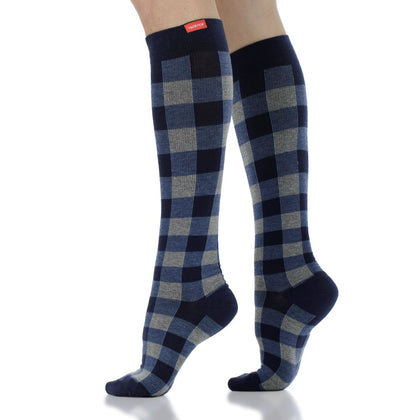
Graduated knee-high compression socks apply gentle pressure to the lower limbs, including the feet, which is well known to boost peripheral circulation. This ensures more blood with oxygen and nutrients reaches the muscles, helping them recover and rebuild on an ongoing basis. Moreover, when you’ve been injured, the improved blood flow is extremely beneficial to speed up recovery (see this 2021 research study for details).
Compression socks also help with plantar fasciitis because they provide support to the lower legs, including the arches of the feet and the calf muscles. This takes pressure off an injured lower leg, reducing the impact of running or walking. It is therefore a good idea to wear them when returning to exercise after you have been diagnosed with plantar fasciitis. They can help prevent re-injury and are versatile garments you can wear anywhere, at any time of day - making them a perfect complement to massage guns.

Stretching and Strengthening Exercises
Recovery from plantar fasciitis usually includes some physiotherapy exercises to strengthen the arch and the lower legs. Foot muscle strength work - such as exercises you’ll find here - also improves mobility in the plantar area, reducing the likelihood of strains and stress in the future.
It is also a good idea to always stretch and warm up adequately before any physical activity. This should include light stretches for your calf muscles and, if running, a few foot drills (such as pogo jumps on the spot and rolling forward heel-to-ankle a few times to improve circulation in the feet).
Speak to a physical therapist to find the best set of exercises for you and add them into a regular routine for best results.
The Importance of Proper Footwear
Supportive running and walking shoes are known to reduce your risk of injury, so you should make sure you have adequate footwear for your activity. The best way to do this is to consult with an in-store specialist - check out your local running store for this. They will be able to assess your gait and see what type of support you need to relieve arch pain and reduce the risk of plantar fasciitis. Often, supportive, cushioned footwear can also be worn all day, for walking or in jobs that require you to be on your feet. Strassburg socks are also a well-known FDA-registered product that help improve pain due to plantar fasciitis.
Using compression socks in conjunction with supportive shoes is a winning combination. You will improve peripheral circulation and support the arches of the feet, while also getting the added benefit of the shoes. And you can count on the graduated compression to warm up the foot and calf muscles, getting you ready to exercise pain-free.
Massage guns are great at-home devices for applying percussive therapy to your muscles. This soothes pain, improves circulation, and improves comfort, all while helping to increase your range of motion. Using massage guns together with compression socks, adequate footwear, and regular stretching and foot strengthening exercises may ease the pain as you recover from plantar fasciitis and, if used consistently, could reduce your risk of getting plantar fasciitis in the future.
References
Borne, R., Hausswirth, C., & Bieuzen, F. (2017). Relationship Between Blood Flow and Performance Recovery: A Randomized, Placebo-Controlled Study. International journal of sports physiology and performance, 12(2), 152–160. Read it here.
Charles, T., Mackintosh, D., Healy, B., Perrin, K., Weatherall, M., & Beasley, R. (2011). Merino wool graduated compression stocking increases lower limb venous blood flow: a randomized controlled trial. Advances in therapy, 28(3), 227–237. Read it here.
Digiovanni, B. F., Nawoczenski, D. A., Malay, D. P., Graci, P. A., Williams, T. T., Wilding, G. E., & Baumhauer, J. F. (2006). Plantar fascia-specific stretching exercise improves outcomes in patients with chronic plantar fasciitis. A prospective clinical trial with two-year follow-up. The Journal of bone and joint surgery. American volume, 88(8), 1775–1781. Read it here.
Ferreira, R. M., Silva, R., Vigário, P., Martins, P. N., Casanova, F., Fernandes, R. J., & Sampaio, A. R. (2023). The Effects of Massage Guns on Performance and Recovery: A Systematic Review. Journal of functional morphology and kinesiology, 8(3), 138. Read it here.
Juchli L. (2021). Effectiveness of Massage Including Proximal Trigger Point Release for Plantar Fasciitis: a Case Report. International journal of therapeutic massage & bodywork, 14(2), 22–29. Read it here.
Kakigi, R., & Shibasaki, H. (1992). Mechanisms of pain relief by vibration and movement. Journal of neurology, neurosurgery, and psychiatry, 55(4), 282–286. Read it here.
Needs, D., Blotter, J., Cowan, M., Fellingham, G., Johnson, A. W., & Feland, J. B. (2023). Effect of Localized Vibration Massage on Popliteal Blood Flow. Journal of clinical medicine, 12(5), 2047. Read it here.
Skinner, B., Dunn, L., & Moss, R. (2023). The Acute Effects of Theragun™ Percussive Therapy on Viscoelastic Tissue Dynamics and Hamstring Group Range of Motion. Journal of sports science & medicine, 22(3), 496–501. Read it here.
Traut, A. G., Hannigan, J. J., Ter Har, J. A., & Pollard, C. D. (2024). Influence of Footwear Selection on Youth Running Biomechanics: A Pilot Study. Sports health, 16(6), 913–919. Read it here.
Yelverton, C., Rama, S., & Zipfel, B. (2019). Manual therapy interventions in the treatment of plantar fasciitis: A comparison of three approaches. Health SA = SA Gesondheid, 24, 1244. Read it here.