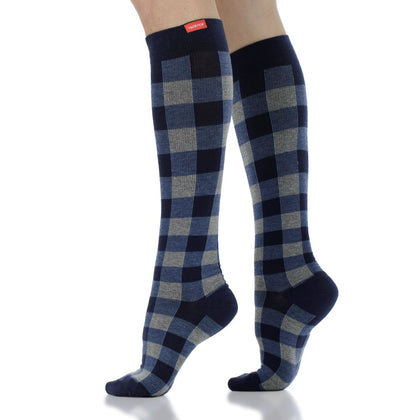
Compression socks are often prescribed by doctors to help a variety of chronic illnesses. Just like any other prescription, things can vary from person to person. The most obvious factor with compression socks is the size. The correct size of sock will ensure that the socks are compressing the right areas of your leg. Scientific studies have found that wearing the correct size of compression sock could provide health benefits like:
Our compression socks come in 6 different sizes, including wide calf varieties, to ensure absolute comfort and function for many bodies. We are constantly pushing ourselves to offer more options to hopefully one day get everyone in stylish compression socks!
Browse our collection of graduated compression socks here!
Knowing your measurements ensures that you will get the compression garment that fits comfortably and provides you with the health benefits you are looking for.
Our compression socks and tights are made with graduated compression technology. Graduated compression is tightest around the lower part of the leg and progressively gets looser towards the top to allow for better blood flow out of the legs and back towards the heart. As you can imagine, accurate sizing is essential for making sure the graduated compression is effective. When wearing the compression socks, here is what you should look for; your garments should not pinch or hurt. They should feel like a gentle hug that supports your legs. Depending on the compression level you get, you may feel more or less of a squeeze. We cover compression levels and their meanings in another article that we encourage you to read.
Discussing where your pain is located with your doctor or Podiatrist is the first step towards deciding what kind of compression product you should get – a sleeve, stocking, or sock. Our compression socks, sleeves, and stockings come in a wide range of sizes, so determining accurate measurements is the key to getting the best fit.
We suggest that you take measurements when you first wake up in the morning, because the swelling in your feet will be at its lowest point. Your limbs—including your legs, calves, and thighs—should be measured with your bare skin exposed. All measurements taken are based on the angle between the sole and the foot or the sole and the leg being bent at approximately 90 degrees for the most accurate measurement. Follow these steps to find your size:
- Mark the widest point of your calf and thigh with a marker.
- Measure the widest part of your calf and take note of the measurement in inches.
- Find your most commonly worn shoe size.
For our compression tights, we use height and weight to help determine size. See the compression tights sizing chart below the compression socks sizing chart.
While we suggest ordering with exact measurements, if you are giving compression socks as a gift, we have a very generous exchange policy to ensure your gift is perfect!
After you’ve completed all the measurements for your calf and have identified your shoe size, you should compare these metrics to our sizing chart below. For compression socks, our chart includes shoe sizes for men, women, and European conversions, as well as calf circumference. You can also find compression sleeves and tights sizing. We look forward to giving you the perfect fit!
Browse our collection of graduated compression socks here!
Olsen, J. H. H., Öberg, S., & Rosenberg, J. (2019). The effect of compression stocking on leg edema and discomfort during a 3-hour flight: A randomized controlled trial. European journal of internal medicine, 62, 54–57. Read it here.
Charles, T., Mackintosh, D., Healy, B., Perrin, K., Weatherall, M., & Beasley, R. (2011). Merino wool graduated compression stocking increases lower limb venous blood flow: a randomized controlled trial. Advances in therapy, 28(3), 227–237. Read it here.
Montoye, A. H. K., Mithen, A. A., Westra, H. L., Besteman, S. S., & Rider, B. C. (2021). The Effect of Compression Socks on Maximal Exercise Performance and Recovery in Insufficiently Active Adults. International journal of exercise science, 14(7), 1036–1051. Read it here.
Ibegbuna, V., Delis, K., & Nicolaides, A. N. (1997). Effect of lightweight compression stockings on venous haemodynamics. International angiology : a journal of the International Union of Angiology, 16(3), 185–188. Read it here.